
China Has Entered the Dark Factory Era Its Fully Automated with No Workers or Lights

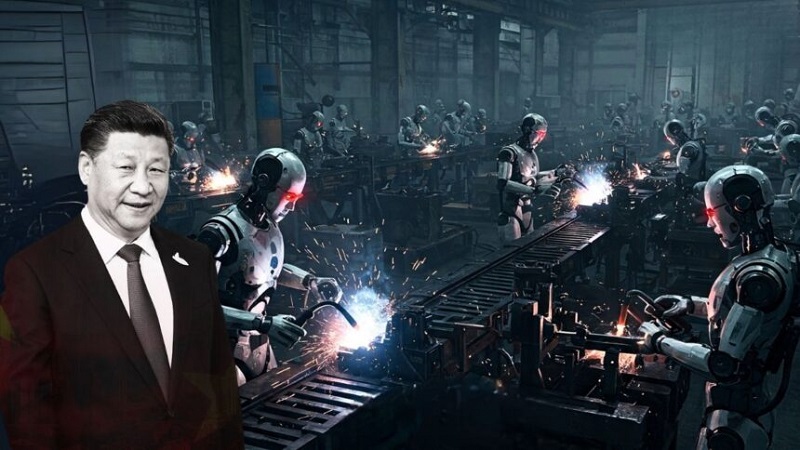

The manufacturing sector is undergoing a revolutionary transformation with the rise of fully autonomous “dark factories.” These advanced production facilities, powered by artificial intelligence (AI), robotics, and the Internet of Things (IoT), operate without human intervention, maximizing efficiency and productivity.
News agency MES reported this in Recently.
China, a global leader in industrial automation, is at the forefront of this shift, rapidly implementing dark factory technology to enhance its manufacturing capabilities.

Dark factories operate 24/7 without human intervention. It’s not like normal factories, they do not need lighting, air conditioning, or worker facilities. Machines, guided by AI and sensors, handle every aspect of production, from assembling products to quality control.
This eliminates human error and maximizes efficiency. These factories also use advanced IoT systems that allow machines to communicate with each other, predicting maintenance needs and reducing downtime.
China has been rapidly adopting automation to stay ahead in the global manufacturing industry. The country installed 290,367 industrial robots in 2022, making up 52% of the world’s total.
The government’s “Made in China 2025” initiative, launched in 2015, focuses on advancing AI, robotics, and smart factories. Heavy investments in automation have positioned China as a leader in industrial innovation.
Major companies are driving this transformation. Foxconn, a leading electronics manufacturer, replaced 60,000 workers with robots in one of its Kunshan factories in 2016. The company plans to automate 30% of its operations by 2025.
BYD, a Chinese electric vehicle (EV) giant, has also embraced automation. Its Shenzhen and Xi’an plants use robotic systems for battery production and vehicle assembly, pushing towards fully automated manufacturing.
The factory operates in darkness, minus a few flashes and sparks as things get welded together. It’s not because they’re trying to cut down on the quarterly power bill, but because none of the factory’s ‘workers’ need light to see. Source: Weibo
Dark factories rely on AI-powered robotics, advanced sensors, and machine learning algorithms. These technologies ensure precision and quality control. Infrared sensors, LIDAR, and computer vision systems allow machines to function efficiently in the dark. Unlike human workers, machines do not need breaks, resulting in continuous production without delays.
Another feature is energy efficiency. Without human workers, there is no need for lighting, heating, or ventilation. The International Energy Agency (IEA) estimates that such automation could reduce industrial energy use by 15-20%. This is a major step towards China’s goal of carbon neutrality by 2060.
The shift to dark factories raises concerns about job losses. Manufacturing employs over 100 million people in China, and increased automation threatens many of these jobs. A 2017 Oxford Economics report estimated that robots could replace 12 million Chinese manufacturing jobs by 2030. In 2023, worker protests in Guangdong highlighted fears about job security as factories embraced automation.
China is investing in workforce retraining programs. The government is encouraging workers to develop skills in AI, robotics maintenance, and data science, fields that are becoming essential in the new industrial era.
China’s rapid automation efforts have intensified global competition. The U.S. had a robot density of 274 per 10,000 manufacturing workers in 2022, while Germany had 415. However, China is advancing quickly, reaching 392 in 2023. To maintain its lead, China invested $1.4 billion in robotics research and development in 2023, according to Bloomberg.
Other countries are also pushing automation. Japan, South Korea, and Germany are expanding smart manufacturing initiatives. The U.S. is investing in AI-driven production systems, aiming to compete with China’s technological advancements.
Dark factories are still in their early stages, but China is making significant progress. High-tech industries like electronics and EV manufacturing are already testing fully automated production. As technology improves, these factories will become more common, setting a new global standard for efficiency and precision.
However, challenges remain. The environmental impact of producing millions of robots and the need for sustainable materials must be addressed. The shift towards automation must be balanced with strategies to support displaced workers.
In 2025, China is leading the way in dark factory development. With continuous investments in AI, robotics, and smart manufacturing, the country is shaping the future of industrial production.
Arthosuchak/
মন্তব্যসমূহ বন্ধ করা হয়.